● 5335 N Harlem Ave, Chicago, IL 60656
● Mon to Sun: 6 AM - 10 PM
Certified Personal Trainer in Chicago
Understand personal trainer certification, credential verification, CPR and AED status, coaching scope, relevant experience, and questions to ask in Chicago.

Working with a certified personal trainer in Chicago should give you confidence that your coach has met defined education or examination requirements—not just that they enjoy working out. Certification creates a professional starting point, but the name of a credential alone does not tell you whether it is current, whether the trainer has experience with your goal, or whether their coaching style suits you.
TONE UP 2 Fitness publishes trainer backgrounds and credentials for its Northwest Chicago coaching team. A free consultation gives you the opportunity to review the person who may coach you, ask how their qualifications apply to your needs, and understand how your plan would be assessed and progressed.
The right question is not simply “Are you certified?” It is “Which current credential do you hold, what does it qualify you to do, and why are you the right coach for my situation?”
What Personal Trainer Certification Means
A professional certification generally indicates that a trainer met eligibility requirements and passed an assessment covering defined knowledge and job tasks. Depending on the certifying body, maintaining the credential may also require continuing education, adherence to professional standards, and current emergency-response training.
Certification should not be confused with a college degree, medical license, physical-therapy license, or dietetics credential. Those qualifications have different education, legal scope, and clinical responsibilities. A personal-training certificate also does not make someone a specialist in every population.
The National Commission for Certifying Agencies accredits certification programs against standards intended to support competent practice and public safety. Accreditation applies to the certification program, not automatically to every course carrying the word “certified.” When comparing trainers, look beyond the acronym and verify the issuing organization, expiration status, and continuing-education requirements.
What Certification Can Show
A credible, current credential can indicate that the trainer has demonstrated entry-level knowledge for a defined role. Relevant areas commonly include client screening, program design, exercise technique, professional responsibilities, and knowing when referral is appropriate.
What Certification Cannot Guarantee
Certification cannot guarantee results, prevent every injury, or prove expertise with your medical history or performance goal. It also does not show how well a trainer listens, communicates, documents progress, or adapts a session. Credentials establish a floor for consideration, not the complete measure of coaching quality.
Why Work With a Certified Trainer
The practical value of certification appears in how the coach makes decisions. A trainer should be able to explain the plan, apply an appropriate progression, and recognize the limits of personal training.
Personalized Plans
A personalized plan connects your objective, starting point, schedule, preferences, and recovery capacity. It does not need to use unusual exercises to be customized. The exercise selection, resistance, repetitions, rest, range of motion, weekly frequency, and progress measures should have a reason.
The trainer should also distinguish preference from contraindication. Disliking an exercise may call for another effective option; a medical restriction requires the program to follow professional guidance.
Risk-Aware Progression
No trainer can guarantee that training is injury-proof. A qualified coach can reduce avoidable mistakes by selecting an appropriate starting level, teaching setup and control, increasing demands gradually, and responding to symptoms responsibly.
Sharp, worsening, or unexplained pain should not be treated as a motivation problem. A trainer should modify or stop the activity and refer the client when evaluation falls outside their scope. Personal training can support general fitness after medical or physical-therapy clearance, but it does not diagnose or rehabilitate an injury.
Accountability and Habit Coaching
Scheduled sessions provide a clear commitment, while progress reviews help turn attendance into useful information. A trainer may also support general habits involving activity, recovery, sleep, and routine. Accountability should be collaborative rather than based on shame, punishment, or unrealistic rules.
Evidence-Informed Methods
Evidence-informed coaching combines current research and professional guidelines with the client’s circumstances and preferences. It does not mean copying a study protocol or attaching scientific language to a trend. Ask how the trainer evaluates new methods, why a particular progression fits your goal, and what would cause them to change the plan.
Programs and Services
TONE UP 2 Fitness verifies private studio, partner, semi-private, personal weight training, and online formats. The best option depends on how much individual observation you need, whether you want to train with others, and where you will complete the program.
| Format | Verified structure | Credential question to ask |
|---|---|---|
| One-on-one training | One client working with one trainer | What experience does this coach have with my goal and starting level? |
| Partner training | Two clients with one trainer | How will exercises be adjusted when the two clients progress differently? |
| Semi-private training | Three clients with one trainer | How much individual observation is practical within the shared session? |
| Personal weight training | Individual coaching focused on resistance training | Which education or experience supports the coach’s strength-programming decisions? |
| Online coaching | Remote programming, check-ins, and feedback | How will technique, adherence, and progress be reviewed remotely? |
Online or Studio Training
ToneUp2 operates a private, appointment-based studio at 5335 N Harlem Avenue and offers online coaching that can support workouts completed at home or another gym. The official site does not list trainer visits to a client’s home as a standard service. Confirm current options rather than interpreting “at-home” as an in-person home visit.
Nutrition and Habit Coaching
ToneUp2 states that its programs may include guidance on basic nutrition and lifestyle habits. A personal trainer can discuss general behaviors within their education and scope, but should not diagnose a nutrition-related condition or provide medical nutrition therapy without the appropriate credential. ToneUp2 states that it refers clients who need clinical nutrition support to registered dietitians.
How Training Works
Certification matters most when it leads to a consistent professional process. ToneUp2 verifies a free consultation, an initial assessment or movement screen, customized programming, coached sessions, and progress tracking. The exact process should still be confirmed for your selected format.
1. Free Consultation
The consultation covers your objective, availability, training history, and preferences. Use it to ask who will coach you and request the full name of their current certification. Discuss relevant health considerations and whether healthcare clearance is appropriate before scheduling training.
2. Movement Assessment
An assessment provides a starting point for exercise selection and progress measures. It may include a health and activity history, observation of relevant movements, and baseline tasks appropriate to the goal. A movement screen is not a diagnostic test and cannot identify the medical cause of pain.
3. Goal and Plan Setup
The coach translates the goal and baseline into a realistic schedule. You should understand which sessions are coached, whether independent workouts are included, what will be measured, and how the plan accounts for other activity.
4. Training Sessions
During sessions, the trainer teaches setup, observes technique, selects resistance, and adjusts the workload. The session should reflect the written plan while leaving room for sensible changes when recovery, symptoms, equipment, or schedule demands differ from expected.
5. Progress Tracking and Adjustments
Progress may be recorded through strength, repetitions, movement quality, conditioning, attendance, body measurements when desired, or performance in a relevant task. Tracking is valuable only when the same information is used to guide the next decision.
Credentials and Experience
TONE UP 2 Fitness lists coaches with credentials from organizations including NCSF, ISSA, NASM, WITS, and Poliquin, alongside selected specialties and experience. Review the studio’s trainer biographies before the consultation, then verify the credentials relevant to the coach you would actually work with.
Verify the Certification
Ask for the complete credential name, issuing organization, and expiration date. Some qualifying credentials can be checked through the United States Registry of Exercise Professionals, which verifies registered professionals holding NCCA-accredited or ISO 17024-compliant credentials from participating organizations. If a credential is not in that registry, use the certifying organization’s official verification process.
A missing registry result does not by itself prove that a credential is invalid; the organization or professional may not participate. It does mean you should request another direct verification method.
Check CPR and AED Status
Emergency readiness is different from exercise-programming knowledge. The current ACSM Certified Personal Trainer requirements include adult CPR/AED certification. Ask whether the trainer’s CPR/AED training is current and includes a practical skills component rather than assuming the personal-training credential covers it.
Match Experience to Your Goal
A general personal-training credential does not automatically establish expertise in youth coaching, prenatal training, post-rehab exercise, older-adult fitness, competitive strength sports, or sport performance. Relevant continuing education and hands-on experience matter. Ask how many clients with similar goals the coach has trained and what modifications or referrals are commonly required.
Understand Scope and Referrals
A certified trainer can design and coach fitness programs within their competence. They should not diagnose an injury, prescribe medication, provide psychotherapy, or deliver medical nutrition therapy without the corresponding qualification. A trustworthy trainer is willing to refer and coordinate with healthcare professionals.
Ask About Insurance and Emergency Procedures
The public ToneUp2 pages reviewed for this article do not specify professional liability insurance coverage. Ask the studio directly whether it maintains appropriate business and professional coverage, how emergencies are handled, and whether incident and health information is documented securely. Do not treat certification as proof of insurance.
Results and Client Proof
Credentials help evaluate the coach; results evidence helps evaluate the process. Neither should be reduced to a dramatic before-and-after photo.
Before-and-After Examples
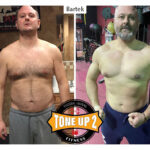
Photos can illustrate an individual experience, but lighting, pose, timing, and selection affect what they show. They do not document strength, health, technique, or sustainability, and another person’s appearance does not predict your outcome.
Client Reviews
Read reviews for repeated details about communication, reliability, respectful coaching, appropriate challenge, and whether the program felt individualized. A large number of vague compliments is less informative than specific descriptions of the coaching relationship.
Case Studies
ToneUp2 publishes client case studies describing individual goals and experiences. Evaluate whether a story identifies the starting problem, the process used, the time context, and meaningful limitations. Testimonials are useful context, not controlled scientific evidence.
Tracked Metrics
Ask which measures will be used for your goal and whether the setup can be repeated. Possible metrics include attendance, resistance, repetitions, range of motion, conditioning, task performance, measurements, or body-composition estimates. The coach should explain both what a metric shows and what it cannot show.
A certified trainer should never guarantee a fixed transformation, amount of weight loss, pain relief, or injury prevention. Results vary with training history, health status, program design, consistency, nutrition, sleep, stress, and recovery.
Frequently Asked Questions
Is every personal trainer certification equivalent?
No. Eligibility, examination, accreditation, continuing education, and renewal requirements vary. Verify the full credential and the standards behind it rather than comparing acronyms alone.
Does certification mean a trainer can work with injuries?
Certification may include screening and modification principles, but it does not make a personal trainer a physician or physical therapist. Active injuries and unexplained symptoms require appropriate clinical evaluation.
Should my trainer have a specialty certification?
It depends on your needs. A specialty credential or relevant continuing education may be valuable for a specific population, but practical experience, current knowledge, communication, and appropriate referrals also matter.
Is online coaching still personal training?
It can be when the program, feedback, and progress reviews are individualized. Ask how the coach will observe technique, communicate changes, and account for the equipment and space available to you.
Can a certified trainer guarantee results?
No. Certification supports professional competence; it does not control every factor affecting results. Look for a clear process and realistic expectations rather than guarantees.
Related Coaching and Fitness Guides
Book Your Consultation
Choosing a certified personal trainer in Chicago should be a verification process, not a leap of faith. Review the trainer’s current credential, CPR/AED status, relevant experience, professional scope, and the way progress will be measured before you commit.
To meet the coaching team and discuss the right format for your goals, book a free consultation with TONE UP 2 Fitness. Bring your questions about certification, experience, services, pricing, and policies so you can make an informed decision.